Showing posts with label WLCG. Show all posts
Showing posts with label WLCG. Show all posts
11 September 2018
Successful DPM/DOME BOF/Hackathon
As part of a side meeting to the GRIDPP41 meeting held in Ambleside this year, we also had a successful BOF/Hackathon meeting. Now I probably should care more about the WN configuration/security hack session, but that really is SEP to me. However the discussion we had regarding Lancaster's DOME deployment and DPM legacy mode in general was useful to understand the DPM roadmap and how we are going to roll out SRM less service at tier 2 sites. This is germane at the moment as some of the features such as 3rd party copy (or TPC as it shall now be known as...) are needed for supporting data activities not just for the WLCG VOs but also some of our smaller communities. (DUNE is an example.)

13 April 2018
Data rates in the UK for last 12 months: Wow alot of data goes bentween the WNs and SEs...
So with me move to new data and work-flow models as a result of the idea to create further storageless sites and caching sites. I decided to take a look at how large data flows within the UK. Caveat Emptor: I took this data from ATLAS dashboard and make the assumption that there is little WAN traffic from WNs to SEs. I am aware this is not correct, but is at the moment a small factor for ATLAS. (Hence why I reviewed ATLAS rather than CMS whom I know use AAA alot.)

In green are the data volumes in UK disk storage, in red are the rates out of the storage. (In blue is the rate for WAN transfers between UK SEs.) In purple shows the rates to and from the RAL tape system. Of notes is that during the month there was 49.1PB of data deleted from UK storage out of a disk cache of ~33PB. What I note form these rate that the 139PB of data ingest from storage into worker nodes and the 11.4PB out from the completed jobs is data that would have had to go on the WAN if WNs were not co-located with SEs.
In green are the data volumes in UK disk storage, in red are the rates out of the storage. (In blue is the rate for WAN transfers between UK SEs.) In purple shows the rates to and from the RAL tape system. Of notes is that during the month there was 49.1PB of data deleted from UK storage out of a disk cache of ~33PB. What I note form these rate that the 139PB of data ingest from storage into worker nodes and the 11.4PB out from the completed jobs is data that would have had to go on the WAN if WNs were not co-located with SEs.
23 February 2018
Lisa, the new sister to "Dave the dataset" makes her appearane.
Hello I 'm Lisa, similar to "Dave the dataset" but born in 2017 in the ATLAS experiment . my DNA number is 2.16.2251. My initial size pf my 23 sub sections is 60.8TB 33651 files. My Main physics subsection is 8.73TB (4726 files). I was born on 9 months ago, in that time I have now produced 1281 unique children corresponding to 129.4TB of data in 60904 files. It i snot surprising that I have a large number of children as I am still relatively new and my children have yet been culled.
It is interesting to see for a relatively new dataset, how many copies of myself and my children there are.
There is 46273 files/ 60.248TB with 1 copy, 35807 files/ 62.06TB with 2 copies, 2959 files/ 4.94TB with 3 copies, 9110 files/ 2.16TB with 4 copies, 51 files/ 0.017GB with 5 copies and 80files/ 0.44GB with 6 copies. Only four real scientist have data which doesn't have a second copy
Analyzing how distributed around the world this data is shows the data is in 100 rooms in total across 67 houses.
Of course more data sets are just about to be created with the imminent restart of the LHC , so we will see how I and new datasets distributions develop.
It is interesting to see for a relatively new dataset, how many copies of myself and my children there are.
There is 46273 files/ 60.248TB with 1 copy, 35807 files/ 62.06TB with 2 copies, 2959 files/ 4.94TB with 3 copies, 9110 files/ 2.16TB with 4 copies, 51 files/ 0.017GB with 5 copies and 80files/ 0.44GB with 6 copies. Only four real scientist have data which doesn't have a second copy
Analyzing how distributed around the world this data is shows the data is in 100 rooms in total across 67 houses.
Of course more data sets are just about to be created with the imminent restart of the LHC , so we will see how I and new datasets distributions develop.
21 February 2018
Dave's Locations in preparation for 2018 data taking.
My powers that be are just about to create more brethren of me in their big circular tunnel. SO I though I would give an update of my locations.
There are currently 479 rooms over 145 houses used by ATLAS. My data is still 8 years on still in 46 rooms in 24 houses. There are 269 individuals. of which 212 are unique , 56 have a twin in another room and one is a triplet. In total this means 13GB of data has double redundancy, 5.48TB has a single redundancy, and 2.45TB has no redundancy. Of note is that 5.28TB of the 7.93TB of data with a twin is from the original produced data.
My main concern is not with those "Dirk" or "Gavin" who are sole children, as they can easily be reproduced in the children "production" factories. Of concern are the 53 "Ursulas" with no redundancy. This equates to 159GB of data/ 6671 files of whose lose would effect 17 real scientists.
There are currently 479 rooms over 145 houses used by ATLAS. My data is still 8 years on still in 46 rooms in 24 houses. There are 269 individuals. of which 212 are unique , 56 have a twin in another room and one is a triplet. In total this means 13GB of data has double redundancy, 5.48TB has a single redundancy, and 2.45TB has no redundancy. Of note is that 5.28TB of the 7.93TB of data with a twin is from the original produced data.
My main concern is not with those "Dirk" or "Gavin" who are sole children, as they can easily be reproduced in the children "production" factories. Of concern are the 53 "Ursulas" with no redundancy. This equates to 159GB of data/ 6671 files of whose lose would effect 17 real scientists.
24 January 2018
Can we see Improvement in IPV6 perfSONAR traffic for the RAL-LCG2 Tier1 site?
In three words (or my TL;DR response would be,) Yes and No.
You may remember I made an analysis of the perfSONAR rates for both IPv4 and IPV6 traffic from the WLCG Tier1 at Rutherford Appleton Laboratory to other WLCG sites. Here is a quick update for new measurements is a plot showing current perfSONAR rates for sites from 8 months ago, their new results, and values for new sites which have been IPV6 enabled and included in official WLCG mesh testing.
What I find interesting is that we still have some sites which have vastly better IPv4 rates rather than IPv6. NB we have 16 sites still with data, 5 sites with no current results and 10 new sites which have been added since the last tranche of measurements.
You may remember I made an analysis of the perfSONAR rates for both IPv4 and IPV6 traffic from the WLCG Tier1 at Rutherford Appleton Laboratory to other WLCG sites. Here is a quick update for new measurements is a plot showing current perfSONAR rates for sites from 8 months ago, their new results, and values for new sites which have been IPV6 enabled and included in official WLCG mesh testing.
 | |
| IPv4 vs IPv6perfSONAR throughput rates between RAL and other WLCG sites. |
10 October 2017
What has IT ever done for physics?
Yesterweek was IT expo in London; audience was very much data centre, IT types, and IT security types, techies and CEOs, from big established companies to startups.
Opening keynote was given by Professor Brian Cox whose talk was titled "Where IT and physics collide." The word "collision" suggests WLCG? or at least something HEPpy, maybe focusing on the data management, the compute that "discovered the Higgs,"
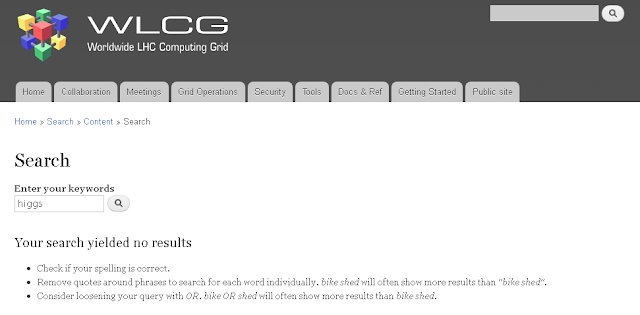
- or, with this being also an IT security conference, the security behind WLCG.
Fortunately, he gave a talk about physics. He talked about LIGO, SDSS, colliding black holes, and, because the organisers asked him to, quantum computing. It was a very engaging talk and everyone enjoyed it. But he did not talk about the IT. Without the computation, we would not know what colliding black holes look like.
And without the WLCG computing infrastructure, we would not have found the Higgs boson.
Prof Cox's friend, Prof Jon Butterworth, who is in ATLAS, does mention the computing in his very enjoyable book "Smashing Physics", but only briefly - it's about a page, plus a few remarks about the other stuff it has done. Which is right, they are both physicists and should talk about the exciting physics that is coming from the LHC and from the other gizmos. But big science needs big compute (and, er, big data.) As we know this sort of stuff doesn't just set itself up or run itself, it requires significant investment and effort. And you can't just "get it in the cloud," not on this scale, and even if you could, it would still require investment and effort.
Incidentally, one of the other things they talked about at the conference: some people are trying to engineer a car that will go 1000 mph. It also needs a lot of computer simulation to design it. But where will it drive - not on British roads...
Opening keynote was given by Professor Brian Cox whose talk was titled "Where IT and physics collide." The word "collision" suggests WLCG? or at least something HEPpy, maybe focusing on the data management, the compute that "discovered the Higgs,"

- or, with this being also an IT security conference, the security behind WLCG.
Fortunately, he gave a talk about physics. He talked about LIGO, SDSS, colliding black holes, and, because the organisers asked him to, quantum computing. It was a very engaging talk and everyone enjoyed it. But he did not talk about the IT. Without the computation, we would not know what colliding black holes look like.
And without the WLCG computing infrastructure, we would not have found the Higgs boson.
Prof Cox's friend, Prof Jon Butterworth, who is in ATLAS, does mention the computing in his very enjoyable book "Smashing Physics", but only briefly - it's about a page, plus a few remarks about the other stuff it has done. Which is right, they are both physicists and should talk about the exciting physics that is coming from the LHC and from the other gizmos. But big science needs big compute (and, er, big data.) As we know this sort of stuff doesn't just set itself up or run itself, it requires significant investment and effort. And you can't just "get it in the cloud," not on this scale, and even if you could, it would still require investment and effort.
Incidentally, one of the other things they talked about at the conference: some people are trying to engineer a car that will go 1000 mph. It also needs a lot of computer simulation to design it. But where will it drive - not on British roads...
20 June 2017
Storage news from HEPSYSMAN
Good news is that I heard some good talks (and possibly gave one) at HEPSYSMAN meeting this week . (Just in time for the WLCG workshop next week.) WE started with a day regarding IPv6 (which other than increasing my knowledge of networking. These talks also highlighted the timescale for storage to be dual homed for WLCG, volume and monitoring of traffic over IPv6 (in Dave Kelsey talk ) and issues with 3rd party transfers (form talk by Tim Chown.)
During HEPSYSMAN proper , many good things from different sites were reported. Of interest is how sites should evolve. Their was also a very interesting talk on comparing RAID6 and ZFS. Slides from the workshop should be available from here:
https://indico.cern.ch/event/592622/
During HEPSYSMAN proper , many good things from different sites were reported. Of interest is how sites should evolve. Their was also a very interesting talk on comparing RAID6 and ZFS. Slides from the workshop should be available from here:
https://indico.cern.ch/event/592622/
03 April 2017
Current storage scope within GridPP
With a new project year upon us, I decided to review which site's storage support is used used by the WLCG VOs, what SRMs are used and the file systems used. On that last part , we now don't just have filesystems but also object stores with the usage of CEPH. Other filesystems are XFS, ZFS, HDFS, Spectrum Scale (or the artist formerly known as GPFS), and Lustre.
In terms of Storage elements/systems we have DPM, dCache, Castor, classic SE, stand alone xrootd, and stand alone gsiftp services. When it comes to the regional T2s and who they are used by, the following helps.

I thought about embedding SE system into the font used for each site, but thought that was too much overlay of information.
In terms of Storage elements/systems we have DPM, dCache, Castor, classic SE, stand alone xrootd, and stand alone gsiftp services. When it comes to the regional T2s and who they are used by, the following helps.
I thought about embedding SE system into the font used for each site, but thought that was too much overlay of information.
02 March 2017
Data Recall Tests from Data from Tape for ATLAS successful... ....ish
The ATLAS VO wanted to test rates achievable to be recalled from Tape system for real data to see what we could achieve. We (RAL) decided to make this even harder on ourselves by getting them to move the date to our new CEPH storage system so as to test further its deployment. This had some success and discovered issues which we have been working to fix. I won't go into all of them here and leave it to others to expand if they wish to other than to say the following.
Data rate was improved by fixing the number of concurrent transfers between the tow storage systems by disabling the auto-configure feature in FTS for the particular FTS "link". We set it to 32 as it had been downgraded to only two due to other issues. This 32 is a value which should be investigated in further tests.
What I will say are the headline figures we achieved. When things were working well,; we were recalling from tape at ~900MB/s and then copying from the Castor disk cache into our object store using (gsiftp protocol) via FTS at 450MB/s. (Total Data Volume expected to be moved was 150TB, but we seem to have seen 230TB of data moved). This was using three gateway machines on the CEPH cluster, 12 disk servers of various quality in the disk cache in castor (with capability of up to 160 concurrent transfers.) This was connected to our tape library which had up to 10 out of 16 tape drives ( this limit is due to an internal tape family setting which we shan't worry about now.)
We also had to worry about other VOs using the system and internal ATLAS contention of resources during the test. There are probably earlier tests that my colleagues have done in the background on the Q.T; but this is the first large Volume data recall and movement combining CEPH and Castor, so thought I would comment on it here for prosperity ( and reference for the next time the test is run.)

Data rate was improved by fixing the number of concurrent transfers between the tow storage systems by disabling the auto-configure feature in FTS for the particular FTS "link". We set it to 32 as it had been downgraded to only two due to other issues. This 32 is a value which should be investigated in further tests.
What I will say are the headline figures we achieved. When things were working well,; we were recalling from tape at ~900MB/s and then copying from the Castor disk cache into our object store using (gsiftp protocol) via FTS at 450MB/s. (Total Data Volume expected to be moved was 150TB, but we seem to have seen 230TB of data moved). This was using three gateway machines on the CEPH cluster, 12 disk servers of various quality in the disk cache in castor (with capability of up to 160 concurrent transfers.) This was connected to our tape library which had up to 10 out of 16 tape drives ( this limit is due to an internal tape family setting which we shan't worry about now.)
We also had to worry about other VOs using the system and internal ATLAS contention of resources during the test. There are probably earlier tests that my colleagues have done in the background on the Q.T; but this is the first large Volume data recall and movement combining CEPH and Castor, so thought I would comment on it here for prosperity ( and reference for the next time the test is run.)
Subscribe to:
Posts (Atom)


