16 December 2007

Anyone for some dCache monitoring?


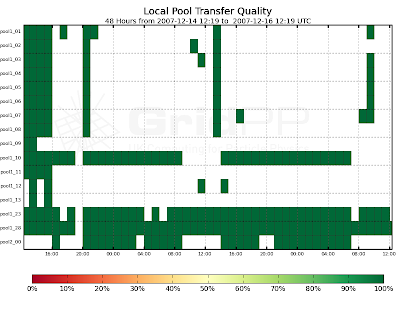
The above plots come from some new dCache monitoring that I have set up to study the behaviour of the Edinburgh production storage (srm.epcc.ed.ac.uk). This uses Brian Bockleman's GraphTool and some associated scripts to query the dCache billing database. You can find the full set of plots here (I know, it's a strange hostname for a monitoring, but it's all that was available):

http://wn3.epcc.ed.ac.uk/billing/xml/

GraphTool is written in python and uses matplotlib to generate the plots. Cherrypy is used for the web interface. The monitoring can't just be installed as an rpm: you need to have PostGreSQL 8.2 available; create a new view in the billing database; set up Apache mod_rewrite; ensure you have the correct compilers installed..., but these steps shouldn't be a problem for anyone.

I think you will agree that the monitoring presents some really useful views of what the dCache is actually doing. It's still a work in progress, but let me know when you want to set it up and I should be able to help.

It should be possible to do something similar for DPM in the coming weeks.

10 December 2007

DPM on SL4

Time to break out the champagne, it looks like DPM will be officially released in production on SL4 next Wednesday.

"Based on the feedback from PPS sites, we think that the following
patches can go to production next Wednesday:


# available on the linked GT-PPS ticket(s)

#1349 glite-LFC_mysql metapackage for SLC4 - 3.1.0 PPS Update 10


#1350 glite-SE_dpm_disk metapackage for SLC4 - 3.1.0 PPS Update 10


#1352 glite-SE_dpm_mysql metapackage for SLC4 - 3.1.0 PPS Update 10


#1541 glite-LFC_oracle metapackage for SLC4 - 3.1.0 PPS Update 10


#1370 R3.1/SLC4/i386 DPM/LFC 1.6.7-1 - 3.1.0 PPS Update 10"


Of course, some sites have been running SL3 DPM on SL4 for over a year and others have been running the development SL4 DPM in production for months. One warning I would give would be to make sure the information publishing is working, I've had a few problems with that in the past (in fact today I was battling with an incompatible version of perl-LDAP from the DAG repository).

06 December 2007

Storage as seen by SAM


We all need more monitoring, don't we? I knocked up these plots showing the storage SAM test results for the ops VO at GridPP sites over the past month. I am only looking at the SE and SRM tests here, where the result for each day is calculated as the number of successes over the total number of tests. The darker-green the square the higher the availability. I think it's clear which sites are having problems.

http://www.gridpp.ac.uk/wiki/GridPP_storage_available_monitoring

We always hear that storage is really unreliable for the experiments, so I was actually quite surprised at the amount of green on the first plot. However, I think since these results are only for the short duration ops tests, they do not truely reflect the view that the experiments have of storage when they are performing bulk data transfer across the WAN or a large amount of local access to the compute farm.

These plots were generated thanks to some great python scripts/tools from Brian Bockleman (and others, I think) from OSG. Brian's also got some interesting monitoring tools for dCache sites which I'm having a look at. It would be great if we could use something similar in GridPP.

04 December 2007

dCache 1.8.0-X

A new patch to dCache 1.8.0 was released on Friday (1.8.0-6). In addition, there is now a 1.8.0 dcap client. All rpms can be found here:

http://www.dcache.org/downloads/1.8.0/index.shtml

Sites (apart from Lancaster!) should wait for all of the Tier-1s to upgrade first of all as there are still some bugs being worked out.

dCache admin scripts

Last week I finally got a chance to have another look at some of the dCache administration scripts that are in the sysadmin wiki [1]. There is a jython interface to the dCache admin interface, but I find it difficult to use. As an alternative, the guys at IN2P3 have written a python module that creates a dCache admin door object which you can then use in your own python scripts to talk to the dCache [2]. One thing that I did was use the rc cleaner script [3] to clean up all of the requests (there were 100's!) that were stuck in Suspended state. You can see how the load on the machine running postgres dropped after removing the entries. Highly recommended.

I also wrote a little script to get information from the LoginBroker in order to print out how many doors are active in the dCache. This is essential information for sites that have many doors (i.e. Manchester) but find the dCache 2288 webpage difficult to use. I'll put it in the SVN repository soon.

[1] http://www.sysadmin.hep.ac.uk/wiki/DCache
[2] http://www.sysadmin.hep.ac.uk/wiki/DCache_python_interface
[3] http://www.sysadmin.hep.ac.uk/wiki/DCache_rc_cleaner

22 November 2007

gridpp-storage turns 1(00)

Just thought I would let everyone know that we have now reached the 100th posting on this little blog and it also happens to fall exactly on the 1 year anniversary of it's creation. Strange how these two milestones coincide like that. Doing the maths, it means that there are about 2 postings per week. What I don't know, however, is whether or not this implies that there is too much or too little to talk about when it comes to Grid storage? Maybe it means I should be doing more work.

As an aside, when I said "everyone" above, I don't actually know how large "everyone" is. As a guess, I would say at most 7 people. Maybe a few comments below would prove me wrong...

Also, I should say that Lancaster are planning on moving to dCache 1.8.0 in production next week. This is great news as it measn they will be all set for the CCRC'08 (the last C means Challenge, that's the important bit) that is due to start 1Q08. Everyone else should have similar plans in their minds.

SRM2.2 deployment workshop - day 2 summary

OK, time to finish off my summary of the workshop; I'll try not to take as long this time.

After a great conference dinner (and amazing speech!) in the George Hotel, I made sure I was in NeSC early on the Wednesday morning to check everything was in working order after the power cut from the previous night. Unfortunately, there were a few gremlins in the system. First of all, a circuit breaker had gone, meaning that only half of the tutorial machines had power, and of those, only half of them had networking. At that point, the hands-on session was basically dead in the water. Fortunately, a University spark (that means electrician) appeared out of nowhere and flicked the switch. A quick reboot and all of the machines came back up - phew! I then had to spend a bit of time reconfiguring a few nodes which the developers had been set loose on; using virtual machines here would definitely have helped, but when I tried this prior to the workshop, the machines at NeSC were really struggling (I've already recommended that they upgrade their hardware). Anyway, the tutorials started and people were able to log on, configure some SRM2.2 spaces and run some client commands as a check. It helped to have the tutorial hand-out that I had prepared along with the dCache and DPM developers (thanks Timur + Sophie).

So far, so good, but disaster wasn't far away as the NeSC firewall had been reset overnight meaning that the tutorial machines could no longer speak to the top-level BDII in the physics department. This was discovered after a quick debug session from Grid guru Maarten Litmaath and the firewall rules were fixed. Unfortunately, this broke wireless connectivity for almost everyone in the building! By far, this was the worst thing that could happen at a Grid meeting - everyone was starting to foam at the mouth by lunch. To be honest, this was the best thing to happen as it meant there were no distractions from the tutorial - something to remember for next time I think ;)

The afternoon kicked off with a discussion about the the rigourous testing that the different SRM2.2 implementations have gone through to ensure they conform to the spec and are able to inter-operate. Things look good so far - fingers crossed in production it reamins the same. We then had a short sessiona about support as this is the latest big thing to talk about with regards to storage. The message that I would give to people is that make sure you stay involved in the community that we have built up; contribute to the mailing list (dpm-user-forum@cern.ch was announced!) and add to the wikis and related material that is on the web. It's really important that we help one another and not constantly pester the developers (although there help will still be needed!). The final session of the workshop talked about the SRM client tools and changes that have been made to them to support SRM2.2. Clearly, sites should have a good working relationship with these tools as they will be one of the mains weapons to check that SRM2.2 configuration is working as expected.

So that's it, the end of the SRM2.2 deployment workshop. I think everyone (well, most) enjoyed their time in Edinburgh and learnt a lot from each other. The hands-on proved a success and this should be noted for future events. Real data is (hopefully!) coming in 2008 so we had better make sure that the storage is prepared for it so that the elusive Higgs can be found! Remember, acting as a community is essential, so make sure that you stay involved!

See you next time.

17 November 2007

SRM2.2 deployment workshop - day 1 summary

So that's the workshop over - it really flew by after all of the preparation that was required to set things up! Thanks to everyone at NeSC for their help with the organisation and operations on the day. Thanks also to everyone who gave presentations and took tutorials at the workshop, I think these really allowed people to learn about SRM2.2 and all of the details required to configure DPM, dCache or StoRM storage at their site.

Day 1 started with parallel dCache Tier-1 and StoRM sessions. It was particularly good for the StoRM developers to get together with interested sites as they haven't had much of a chance to do this before. For dCache (once the main developer arrived!), FZK and NDGF were able to pass on information to the developers and other Tier-1s about performing the upgrade to v1.8.0. It was noted that NDGF are currently just using 1.8.0 as a drop in replacement for 1.7.0 - space management has yet to be turned on. FZK had experienced a few more problems - primarily due to a high load on PNFS. However, the eventual cause was traced to a change in pool names without a subsequent re-registration - this is unrelated to 1.8.0.

I had arranged for lunch for the people who turned up in the morning. Of course, I should have known that a few extras would have turned up - but I didn't expect quite as many. Luckily we had enough food, just. I'll know better for next time!

The main workshop started in the afternoon where the concepts of SRM2.2 were presented in order to educate sites and give them the language that would be used during the rest of the workshop. Thanks to Flavia Donno and Maarten Litmaath describing the current status. We then moved onto short presentations from each of the storage developers, outlining the system and how SRM2.2 was implemented. Again, this helped to explain concepts to sites and enabled them to see the differences with the software that is currently deployed.

Stephen Burke gave a detailed presentation about v1.3 of the GLUE schema. This is important as it was introduced to allow for SRM2.2 specific information to be published in the information system. Sites need to be aware of what their SEs should be publishing - there should be a SAM test that will check this out.

The final session of the day was titled "What do experiments want from your storage?". I was hoping that we could get a real idea of how ATLAS, CMS and LHCb would want to use SRM2.2 at the sites, particularly Tier-2s. LHCb appear to have the clearest plan of what they want to do (although they don't want to use Tier-2 disk) as they were presenting exactly the data types and space tokens that they would like set up. CMS presented gave a variety of ideas for how they could use SRM2.2 to help with the data management. While these are not finalised I think they should form the basis for further discussion between all interested parties. For ATLAS, Graeme Stewart gave another good talk about their computing model and data management. Unfortunately, it was clear that ATLAS don't really have a plan for SRM2.2 at Tier-1s or 2s. He talked about ATLAS_TAPE and ATLAS_DISK space tokens, which is a start, but what is the difference between this and just having separate paths (atlas/disk and atlas/tape) in the SRM namespace? What was clear, however, was that ATLAS (and the other experiments) want storage to be available, accessible and reliable. This is essential for both WAN data transfers and local access for compute jobs and is really what the storage community have to focus on prior to the start of data taking - we are here for the physics after all!

So, Day 1 went well, that is until we had a power cut just after the final talk! To be honest though, it turned out to be a good thing as it meant people stopped working on their laptops and got out to the pub. This was another reason for having the workshop - allowing people to mix and match faces to the names that they have seen on the mailing lists. It all helps to foster that community spirit that we need to support each other,

OK, enough for now. I'll talk about Day 2 later.

SRM2.2 deployment workshop - picture gallery


If people have any more photos that they would like to share, then feel free to send them to me.

16 November 2007

Storage workshops - the solution to (most of) our problems


While reviewing the outcomes of the workshop, I have come to the conclusion that we should have storage workshops more often as they clearly improve the reliability and availability of Grid storage. I took this snapshot of SAM test results for UK sites the day after the Edinburgh meeting and I think it's obvious that there is a lot of green about, although one site shall remain nameless...

Unfortunately, normal service appears to have resumed. So who is planning the next meeting?

14 November 2007

Dark storage?

The lights went out on the SRM2.2 deployment workshop yesterday evening, but it was timed to perfection as the final talk had just finished! Clearly my plan to get everyone out of the building worked really well ;)

Dinner in the George Hotel was excellent (as was the beer afterwards), I will post some photos from the restaurant and day-1 at some point today.

10 November 2007

SRM2.2 deployment workshop - bulletin 5


View Larger Map

The workshop is almost upon us, I can't believe it's come round this fast! It was only a few weeks ago that I was proposing the idea of running this event. Preparations have been continuing apace and I now have the computer lab set up with 20 dCache and DPM test instances. Interested participants will use their laptops to connect to these machines during the tutorials and will configure the SRM2.2 service. There will be contributions from many sources during the workshop; the developers, experiment representatives and members of the WLCG GSSD are all putting together material. Thanks to everyone for all of their efforts!

The map above pinpoints some of the main locations that you will need to know about during the workshop. Hopefully you'll get the chance to see some more of Edinburgh's attractions while you are here.

Check Indico for the latest agenda:

http://indico.cern.ch/conferenceDisplay.py?confId=21405

Note that we have added a discussion session about the future of storage support. This is important given that (fingers crossed) we will be receiving physics data next year; we need to ensure the storage services have high availability and reliability.

See you next week.

02 November 2007

SRM2.2 deployment workshop - bulletin 4

We are now up to 55 registered participants! This is great - clearly a lot of people are interested in learning about SRM and the workshop presents a good opportunity for everyone to meet the middleware developers; find out about basics (and the complexities) of SRM2.2 and exchange hints/tips with site admins from all over WLCG.

I would ask everyone to come prepared for the workshop - have a think about your current storage setup and how this will be changing over the coming year. I would imagine everyone will be buying more disk so how do you want this set up? If you support many VOs, do you want to give dedicated disk to some of them while the others share?

Also, I've worked out some more of the technicalities of the hands on session. There are 20 desktop machines at NeSC which we can use for the tutorial and I have started setting up dCache/DPM images which will be rolled out across the cluster. I'll ask everyone to use their laptops to ssh onto the machines, but everyone will have to work in pairs; unfortunately there aren't hosts for one each. We'll be using a temporary CA for host and user certificates.

Finally, just to clarify that the workshop starts at 1pm on Tuesday 13th Nov. Make sure you pick up some lunch beforehand! You should be able to find plenty of eateries near to NeSC. Looking forward to see you all soon.

http://indico.cern.ch/conferenceDisplay.py?confId=21405

25 October 2007

SRM2.2 deployment workshop - bulletin 3

Just thought I would give a quick update as to the organisation of the workshop. First of all, thanks to those who have already registered - we are fast approaching our limit and the registration page will be closed soon (so apply now if you still would like to come).

http://www.nesc.ac.uk/esi/events/827/

Secondly, I have changed the format of the Indico agenda page to use the "conference" format. Hopefully this makes more sense since we are having a couple of parallel sessions during the workshop which was difficult to see from the default layout.

Thirdly, I am working with people at NeSC to try and setup a hands on session where delegates get a chance to "play" with the SRM2.2 configuration on a dCache or DPM. At the moment there are still some technical "challenges" to overcome. I'll keep you posted.

As always, get in touch if there are any questions.

PS Can anyone name the tartan?

16 October 2007

SRM2.2 deployment workshop - bulletin 2


The registration page for the workshop is now available.

http://www.nesc.ac.uk/esi/events/827/

Could everyone who has pre-registered their interest to me please complete the registration form. If you require accommodation you should select the relevant nights and this will be booked for you by NeSC (they will not be paying for it though!). I have a list of names of those who have pre-registered, so I'll be chasing up anyone who does not fill out the form.

The agenda can be found here:

http://indico.cern.ch/conferenceDisplay.py?confId=21405

If you have any SRM or storage issues that you would like raised at the workshop, please let me know and I will try to ensure that it is covered at some stage.

Looking forward to seeing you in Edinburgh!

12 October 2007

OSG storage group

I was in a meeting yesterday with the OSG data storage and management group. I had realised that there was some activity going on in the US regarding this, but didn't know just how many people are involved, or what precisely they were doing. Turns out that there is actually quite a few FTEs looking at dCache 1.8 testing, client tools, deployment scripts, bug reports and support. There is clearly quite an overlap with what we try to do in GridPP, although there are a couple of differences:

1. GridPP has only me (and part of Jens) dedicated to storage. The rest comes from the community of site admins that have signed up to the mailing list. This works well, but it would be good if there were others who could dedicate more time to looking at storage issues. There were previously a couple of positions at RAL for this stuff. Hopefully there will be again in GridPP3.

2. Unlike GridPP, OSG is not dedicated to particle physics, hence they support other user communities. It appears that USATLAS and USCMS take on the lions share of support for storage at US Tier-2 sites.

You can find more information here:

https://twiki.grid.iu.edu/twiki/bin/view/Storage/

06 October 2007

Interview with ZFS techies - mentions LHC

These guys (Jeff Bonwick and Bill Moore) are techies so not a sales pitch at all. Running time about 48 mins but you can do something else and just listen to it (like in a meeting :-)

http://www.podtech.net/scobleshow/technology/1619/talking-storage-systems-with-suns-zfs-team

Suitable for everyone, covers a lot of software engineering ("software is only as good as its test suite") but also obviously filesystems and "zee eff ess" and storage.

Also mentions CERN's LHC, and the LHC Atlas detector in particular.
And work done by CERN to examine silent data corruption (at around 33 mins into the interview).

01 October 2007

SRM2.2 deployment workshop - bulletin 1

This is the first bulletin for the "SRM2.2 Deployment Workshop" which will take place on Tuesday the 13th and Wednesday the 14th of November 2007. The workshop is being organised by the UK's National eScience Centre (NeSC), GridPP and WLCG. It will take place at NeSC, Edinburgh, Scotland.

The goal of the workshop is to bring WLCG site administrators with experience of operating dCache and DPM storage middleware together with the core developers and other Grid storage experts. This will present a forum for information exchange regarding the deployment and operation of
SRM2.2 services on the WLCG. By the end of the workshop, site administrators will be fully aware of the technology that must be deployed in order to provide a service that fully meets the needs of the LHC physics programme.

Particular attention will be paid to the large number of sites who contribute small amounts of computing and storage resource (Tier-2s), as compared with national laboratories (Tier-1s). Configuration of SRM2.2 spaces and storage information publishing will be the main topics of
interest during the workshop. In addition, there will be a dedicated session for the Tier-1 sites running dCache.

As SRM2.2 has been proposed as an Open Grid Forum (OGF) standard, it is likely that the workshop will be of wider interest than only WLCG. However, it should be noted that the intention of the meeting is not to continue discussions of the current specification or of any future
version. The meeting will focus on the deployment of a production system.
It is intended that the meeting will be by invitation only. Anyone who thinks that they should receive an invitation should contact Greig Cowan to register their interest.

A detailed agenda and general information about the event are currently being prepared. A second announcement will be made once these are in place.

28 September 2007

DPM Dies

For those who don't read the ScotGRID blog:

http://scotgrid.blogspot.com/2007/09/dpm-dies.html

Filesystems turn readonly

Some of the RAID'ed filesystems at Edinburgh recently decided that they would become readonly. This caused the dCache pool processes that depended on them to fall over (Repository got lost). Some of the affected filesystems were completely full, but not all of them. An unmount/mount cycle seems to have fixed things. Anyone seen this sort of thing before?