Further news regarding jobs that run on me. I have now been reprocessed at RAL!!
5036 jobs. Click job number to see details.
States: running:35 holding:1 finished:3989 failed:1011
Users (6): A:24 B:828 C:446 D:1944 E:15 F:1779
Releases (3): A1:828 A2:4134 A3:74
Processing types (3): pathena 1298 reprocessing:1779 validation:1959
Job types (2): managed:3738 user:1298
Transformations (2): Reco.py:3738 runAthena:1298
Sites (11): CERN:24 IFIC:1274 CERN-RELEASE:76 RAL:3410 Brunel:32 QMUL:20 UCL:45 LANCS:59 GLASGOW:66 CAM:10 RALPPP:20
Most of these jobs within the UK are only Validation jobs (a mix of sites which fail or succeed). Really strange since the dataset location has not changed ( still only at CERN,RAL and IFIC).
Large number of reprocessing jobs have been completed at RAL as you would expect.
Derived datasets now at RAL are multiplying like rabbits; including *sub* datasets there are 197 children of Dave. Ignoring the subs, there are 65 parents. Into total there are 2444 files associated with Dave!
These look like:
data10_7TeV..physics_MinBias.merge.AOD.*
data10_7TeV..physics_MinBias.merge.DESD_MBIAS.*
data10_7TeV..physics_MinBias.merge.DESDM_EGAMMA.*
data10_7TeV..physics_MinBias.merge.DESD_MET.*
data10_7TeV..physics_MinBias.merge.DESD_PHOJET.*
data10_7TeV..physics_MinBias.merge.DESD_SGLEL.*
data10_7TeV..physics_MinBias.merge.DESD_SGLMU.*
data10_7TeV..physics_MinBias.merge.ESD.*
data10_7TeV..physics_MinBias.merge.HIST.*
data10_7TeV..physics_MinBias.merge.log.*
data10_7TeV..physics_MinBias.merge.NTUP_MUONCALIB.*
data10_7TeV..physics_MinBias.merge.NTUP_TRKVALID.*
data10_7TeV..physics_MinBias.merge.TAG.*
data10_7TeV..physics_MinBias.merge.TAG_COMM.*
data10_7TeV..physics_MinBias.recon.ESD.*
data10_7TeV..physics_MinBias.recon.HIST.*
data10_7TeV..physics_MinBias.recon.log.*
data10_7TeV..physics_MinBias.recon.NTUP_TRKVALID.*
data10_7TeV..physics_MinBias.recon.TAG_COMM.*
valid1..physics_MinBias.recon.AOD.*
valid1..physics_MinBias.recon.DESD_MBIAS.*
valid1..physics_MinBias.recon.DESDM_EGAMMA.*
valid1..physics_MinBias.recon.DESD_MET.*
valid1..physics_MinBias.recon.DESD_SGLMU.*
valid1..physics_MinBias.recon.ESD.*
valid1..physics_MinBias.recon.HIST.*
valid1..physics_MinBias.recon.log.*
valid1..physics_MinBias.recon.NTUP_MUONCALIB.*
valid1..physics_MinBias.recon.NTUP_TRIG.*
valid1..physics_MinBias.recon.NTUP_TRKVALID.*
valid1..physics_MinBias.recon.TAG_COMM.*
I also had children copied to LOCALGROUPDISK at
UKI-NORTHGRID-LANCS-HEP_LOCALGROUPDISK
and
UKI-LT2-QMUL_LOCALGROUPDISK
Plus 17 Users have put betweeen 1-3 datsets each (totaling 24 datasests) into SCRATCHDISK space tokens across 6 T2
sites within the UK ( number of SCRATCHDISK datsets at these six sites are 1,1,4,6,10.
27 April 2010

16 April 2010
Been on my holidays and plans for the future.
Been cloned to spanish LOCALGROUPDISK.
6120 jobs. Click job number to see details.
States: finished:504 failed:5616
Users (3): A:1890 B:1114 C:3116
Releases (3): 1:47 2:1114 3:4959
Processing types (2): ganga:2670 pathena:3450
Job types (1): user:6120
Transformations (1): 1:6120
Sites (3): ANALY_CERN:1823 ANALY_FZK:67 ANALY_IFIC:4230
( Not sure how the jobs in Germany worked since according to dq2-ls I am only at RAL and IFIC. Also want to find out from where I was copied from when copied to IFIC; Ie was it direct from CERN or RAL; or did I go via PIC. IF I did go via PIC, how long was I there before being deleted? )
I expect to be reprocessed soon so it will be intersting to see how I spread and to see older versions of my children get deleted.
6120 jobs. Click job number to see details.
States: finished:504 failed:5616
Users (3): A:1890 B:1114 C:3116
Releases (3): 1:47 2:1114 3:4959
Processing types (2): ganga:2670 pathena:3450
Job types (1): user:6120
Transformations (1): 1:6120
Sites (3): ANALY_CERN:1823 ANALY_FZK:67 ANALY_IFIC:4230
( Not sure how the jobs in Germany worked since according to dq2-ls I am only at RAL and IFIC. Also want to find out from where I was copied from when copied to IFIC; Ie was it direct from CERN or RAL; or did I go via PIC. IF I did go via PIC, how long was I there before being deleted? )
I expect to be reprocessed soon so it will be intersting to see how I spread and to see older versions of my children get deleted.
07 April 2010
A Busy week for Dave the Dataset
I am only eight days old and already I am prolific.
I now have 51 descendant datasets.
Only some of these have been copied to RAL:
Those are
data10_7TeV.X.physics_MinBias.merge.AOD.f235_m427
data10_7TeV.X.physics_MinBias.merge.AOD.f236_m427
data10_7TeV.X.physics_MinBias.merge.AOD.f239_m427
data10_7TeV.X.physics_MinBias.merge.DESD_MBIAS.f235_m428
data10_7TeV.X.physics_MinBias.merge.DESD_MBIAS.f236_m428
data10_7TeV.X.physics_MinBias.merge.DESD_MBIAS.f236_m429
data10_7TeV.X.physics_MinBias.merge.DESD_MBIAS.f239_m428
data10_7TeV.X.physics_MinBias.merge.DESD_MBIAS.f239_m429
data10_7TeV.X.physics_MinBias.merge.DESDM_EGAMMA.f235_m428
data10_7TeV.X.physics_MinBias.merge.DESDM_EGAMMA.f236_m428
data10_7TeV.X.physics_MinBias.merge.DESDM_EGAMMA.f236_m429
data10_7TeV.X.physics_MinBias.merge.DESDM_EGAMMA.f239_m428
data10_7TeV.X.physics_MinBias.merge.DESDM_EGAMMA.f239_m429
data10_7TeV.X.physics_MinBias.merge.DESD_PHOJET.f235_m428
data10_7TeV.X.physics_MinBias.merge.DESD_PHOJET.f236_m428
data10_7TeV.X.physics_MinBias.merge.DESD_PHOJET.f236_m429
data10_7TeV.X.physics_MinBias.merge.DESD_PHOJET.f239_m428
data10_7TeV.X.physics_MinBias.merge.DESD_PHOJET.f239_m429
data10_7TeV.X.physics_MinBias.merge.DESD_SGLEL.f235_m428
data10_7TeV.X.physics_MinBias.merge.DESD_SGLEL.f236_m428
data10_7TeV.X.physics_MinBias.merge.DESD_SGLEL.f236_m429
data10_7TeV.X.physics_MinBias.merge.DESD_SGLEL.f239_m428
data10_7TeV.X.physics_MinBias.merge.DESD_SGLEL.f239_m429
data10_7TeV.X.physics_MinBias.merge.RAW
data10_7TeV.X.physics_MinBias.merge.TAG_COMM.f235_m426
data10_7TeV.X.physics_MinBias.merge.TAG_COMM.f236_m426
data10_7TeV.X.physics_MinBias.merge.TAG.f235_m427
data10_7TeV.X.physics_MinBias.merge.TAG.f236_m427
data10_7TeV.X.physics_MinBias.merge.TAG.f239_m427
As you can see this is a wild range of file types.
Volumes contained in each dataset in terms of size and number of events varies greatly. of the ~65k events in my RAW form, only 1or 2 events have survived into some child datasets.
Of the 10 T2s currently associated with RAL data distribution of real data for ATLAS , some of my children have gone to 8 of them. Those children which have been distributed are being cloned into two copies and sent to different T2s following the general ATLAS model and the Shares decided for the UK.
A break in the initial data model is expected and ESD will be sent to T2s. Let us see how long it takes for this to happen.....
I and my children have also being analysed by jobs on WNs in various countries and by multiple users.
For the three AOD datasets:
The first incarnation was analysed by:
2 Users spread over
2 sites over
2 releases of which
0/11 were analyzed at UK sites all of which were analyzed by
pathena
The second incarnation was analysed by:
29 Users spread over
20 sites over
8 releases of which
94/1032 jobs were analyzed at ANALY_RALPP and ANALY_SHEF all using
pathena
The 3rd incarnation has so far been analysed by:
10 Users spread over
11 sites over
3 releases of which
9/184 jobs were analyzed at ANALY_OX using both
pathena and ganga
I now have 51 descendant datasets.
Only some of these have been copied to RAL:
Those are
data10_7TeV.X.physics_MinBias.merge.AOD.f235_m427
data10_7TeV.X.physics_MinBias.merge.AOD.f236_m427
data10_7TeV.X.physics_MinBias.merge.AOD.f239_m427
data10_7TeV.X.physics_MinBias.merge.DESD_MBIAS.f235_m428
data10_7TeV.X.physics_MinBias.merge.DESD_MBIAS.f236_m428
data10_7TeV.X.physics_MinBias.merge.DESD_MBIAS.f236_m429
data10_7TeV.X.physics_MinBias.merge.DESD_MBIAS.f239_m428
data10_7TeV.X.physics_MinBias.merge.DESD_MBIAS.f239_m429
data10_7TeV.X.physics_MinBias.merge.DESDM_EGAMMA.f235_m428
data10_7TeV.X.physics_MinBias.merge.DESDM_EGAMMA.f236_m428
data10_7TeV.X.physics_MinBias.merge.DESDM_EGAMMA.f236_m429
data10_7TeV.X.physics_MinBias.merge.DESDM_EGAMMA.f239_m428
data10_7TeV.X.physics_MinBias.merge.DESDM_EGAMMA.f239_m429
data10_7TeV.X.physics_MinBias.merge.DESD_PHOJET.f235_m428
data10_7TeV.X.physics_MinBias.merge.DESD_PHOJET.f236_m428
data10_7TeV.X.physics_MinBias.merge.DESD_PHOJET.f236_m429
data10_7TeV.X.physics_MinBias.merge.DESD_PHOJET.f239_m428
data10_7TeV.X.physics_MinBias.merge.DESD_PHOJET.f239_m429
data10_7TeV.X.physics_MinBias.merge.DESD_SGLEL.f235_m428
data10_7TeV.X.physics_MinBias.merge.DESD_SGLEL.f236_m428
data10_7TeV.X.physics_MinBias.merge.DESD_SGLEL.f236_m429
data10_7TeV.X.physics_MinBias.merge.DESD_SGLEL.f239_m428
data10_7TeV.X.physics_MinBias.merge.DESD_SGLEL.f239_m429
data10_7TeV.X.physics_MinBias.merge.RAW
data10_7TeV.X.physics_MinBias.merge.TAG_COMM.f235_m426
data10_7TeV.X.physics_MinBias.merge.TAG_COMM.f236_m426
data10_7TeV.X.physics_MinBias.merge.TAG.f235_m427
data10_7TeV.X.physics_MinBias.merge.TAG.f236_m427
data10_7TeV.X.physics_MinBias.merge.TAG.f239_m427
As you can see this is a wild range of file types.
Volumes contained in each dataset in terms of size and number of events varies greatly. of the ~65k events in my RAW form, only 1or 2 events have survived into some child datasets.
Of the 10 T2s currently associated with RAL data distribution of real data for ATLAS , some of my children have gone to 8 of them. Those children which have been distributed are being cloned into two copies and sent to different T2s following the general ATLAS model and the Shares decided for the UK.
A break in the initial data model is expected and ESD will be sent to T2s. Let us see how long it takes for this to happen.....
I and my children have also being analysed by jobs on WNs in various countries and by multiple users.
For the three AOD datasets:
The first incarnation was analysed by:
2 Users spread over
2 sites over
2 releases of which
0/11 were analyzed at UK sites all of which were analyzed by
pathena
The second incarnation was analysed by:
29 Users spread over
20 sites over
8 releases of which
94/1032 jobs were analyzed at ANALY_RALPP and ANALY_SHEF all using
pathena
The 3rd incarnation has so far been analysed by:
10 Users spread over
11 sites over
3 releases of which
9/184 jobs were analyzed at ANALY_OX using both
pathena and ganga
31 March 2010
The Fall and Rise of Dave the Dataset
Hello, my full name is data10_7TeV.%$%$%$%$%.RAW but you can call me Dave. I am a dataset within ATLAS. Here I will be blogging my history and that of all the dataset replicas and children datasets that the physicists produce from me.
I came about from data taking at the LHC on the 30th March 2010 from the ATLAS detector.
I initially have 1779 files containing 675757 events. I was born a good 3.13TB
By the end of my first day I have already been copied so that I exist in two copies on disk and two sets of tape. This should result on my continual survival so as to avoid loss.
So I am now secure in my own existance; lets see if any one care to read me or move to different sites.
I came about from data taking at the LHC on the 30th March 2010 from the ATLAS detector.
I initially have 1779 files containing 675757 events. I was born a good 3.13TB
By the end of my first day I have already been copied so that I exist in two copies on disk and two sets of tape. This should result on my continual survival so as to avoid loss.
So I am now secure in my own existance; lets see if any one care to read me or move to different sites.
30 March 2010
Analysing a node chock full of analysis.
As Wahid's previous post notes, we've been doing some testing and benchmarking of the performance of data access under various hardware and data constraints (particularly: SSDs vs HDDs for local storage, "reordered" AODs vs "unordered" AODs, and there are more dimensions to be added).
 Node 300 (above)
 Node 305 (above)
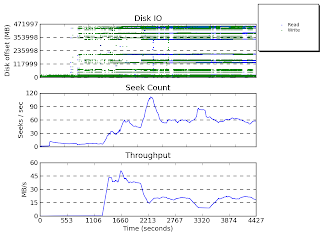

Although this is a little preliminary, I took some blktrace traces of the activity on a node with an SSD (an Intel X25 G2) mounted on /tmp, and a node with a standard partition of the system HDD as /tmp, whilst they coped with being filled full of HammerCloud-delivered muon analysis jobs. Each trace was a little over an hour of activity, starting with each HammerCloud test's start time.
Using seekwatcher, you can get a quick summary plot of the activity of the filesystem during the trace.
In the following plots, node300 is the one with the HDD, and node305 is the one with the SDD.
Firstly, under stress from analysis of the old AODs, not reordered:
 Node 300 (above)
 Node 305 (above)
 As you can see, the seek rates for the HDD node hit the maximum expected seeks per second for a 7200 rpm device (around 120 seeks per second), whilst the seeks on the SSD peak at around 2 to 2.5 times that. The HDD's seek rate is a significant limit on the efficiency of jobs under this kind of load.
Now, for the same analysis, against reordered AODs. Again, node300 first, then node305.


Notice that the seek rate for both the SSD and the HDD peak below 120 seeks per second, and the sustained seek rate for both of them is around half that. (This is with both nodes loaded completely with analysis work).
So, reordering your datasets definitely improves their performance with regard to seek ordering...
So, reordering your datasets definitely improves their performance with regard to seek ordering...
26 March 2010
Testing times
Data analysis at grid sites is hard on poor disk servers. This is part because of the "random" access pattern seen on accessing jobs. Recently LHC experiments have been "reordering" their files to match more the way they might be expected to be accessed.
Initially the access pattern on these new files looks more promising as these plots showed.
But those tests read the data in the new order so are sure to see improvements. Also, as the plots hint at, any improvement is very dependent on access method, file size, network config and a host of other factors.
So recently we have been trying accessing these datasets with real ATLAS analysis type jobs at Glasgow. Initial indications look like the improvement will not be quite as much as hoped but tests are ongoing so we'll report back.
Initially the access pattern on these new files looks more promising as these plots showed.
But those tests read the data in the new order so are sure to see improvements. Also, as the plots hint at, any improvement is very dependent on access method, file size, network config and a host of other factors.
So recently we have been trying accessing these datasets with real ATLAS analysis type jobs at Glasgow. Initial indications look like the improvement will not be quite as much as hoped but tests are ongoing so we'll report back.
04 March 2010
Checksumming and Integrity: The Challenge
One key focus of the Storage group as whole at the moment is the thorny issue of data integrity and consistency across the Grid. This turns out to be a somewhat complicated, multifaceted problem (the full breakdown is on the wiki here), and one which already has fractions of it solved by some of the VOs.
ATLAS, for example, has some scripts managed by Cedric Serfon which do the checking of data catalogue consistency correctly, between ATLAS's DDM system, the LFC and the local site SE. They don't, however, do file checksum checks, and therefore there is potential for files to be correctly placed, but corrupt (although this would be detected by ATLAS jobs when they run against the file, since they do perform checksums on transferred files before using them).
The Storage group has an integrity checker which does checksum and catalogue consistency checks between LFC and the local SE (in fact, it can be run remotely against any DPM), but it's much slower than the ATLAS code (mainly because of the checksums).
Currently, the plan is to split effort between improving VO specific scripts (adding checksums), and enhancing our own script - one issue of key importance is that the big VOs will always be able to write specific scripts for their own data management infrastructures than we will, but the small VOs deserve help too (perhaps more so than the big ones), and all these tools need to be interoperable. One aspect of this that we'll be talking about a little more in a future blog post is standardisation of input and output formats - we're planning on standardising on SynCat, or a slightly-derived version of SynCat, as a dump and input specifier format.
This post exists primarily as an informational post, to let people know what's going on. More detail will follow in later blog entries. If anyone wants to volunteer their SE to be checked, however, we're always interested...
01 March 2010
A Phew Good Files
The storage support guys finished integrity checking of 5K ATLAS files held at Lancaster and found no bad files.
This, of course, is a Good Thing™.
The next step is to check more files, and to figure out how implementations cache checksums. Er, the next two steps are to check more files and document handling checksums, and do it for more experiments. Errr, the next three steps are to check more files, document checksum handling, add more experiments, and integrate toolkits more with experiments and data management tools.
There have been some reports of corrupted files but corruptions can happen for more than one reason, and the problem is not always at the site. The Storage Inquisition investigation is ongoing.
This, of course, is a Good Thing™.
The next step is to check more files, and to figure out how implementations cache checksums. Er, the next two steps are to check more files and document handling checksums, and do it for more experiments. Errr, the next three steps are to check more files, document checksum handling, add more experiments, and integrate toolkits more with experiments and data management tools.
There have been some reports of corrupted files but corruptions can happen for more than one reason, and the problem is not always at the site. The Storage Inquisition investigation is ongoing.
22 December 2009
T2 storage Ready for ATLAS Data Taking.. Or are we??
Been a busy couple of Months really; what with helping the Tier2 sites to prepare their storage for data taking.... Good news is the sites have done really well.
Of the three largest LHC VOs, most work has been done with ATLAS; (since they have the hungriest need for space and complexity for site administration of Tier2 space.)
All sites now have the space tokens for atlas that they require.
http://www.hep.lancs.ac.uk/~love/ukdata/
The ATLAS people have also been ready to see what space is available to them adjust there usage to this.
http://atlddm02.cern.ch/dq2/accounting/cloud_view/UKSITES/30/
http://atladcops.cern.ch:8000/drmon/crmon_TiersInfo.html
Almost all sites had either their SE/SRMs in the process of upgrade/decommissioning ready for data taking in '09 and all should be ready for '10.
Sites were very good at making changes needed by the ATLAS changing needs of space token distribution.
Sites have also been really good in working with ATLAS via atlas "hammercloud" tests to improve their storage.
Some issues still remain (Draining on DPM, limiting gridFTP connections etc, lost disk server process, data management by the VOs etc) but these challenges/opportunities will make our lives "interesting" over the coming months..
So that covers some of the known knowns.
The known unknowns ( how user analysis of real data affects on T2 storage) are also going to come about over the next few months, but I feel both the GRIDPP-Storage team, the atlas-uk support team and the site admins are ready to face what the LHC community throw at us.
Unknown unknowns; we will deal with then when they come at us....
Of the three largest LHC VOs, most work has been done with ATLAS; (since they have the hungriest need for space and complexity for site administration of Tier2 space.)
All sites now have the space tokens for atlas that they require.
http://www.hep.lancs.ac.uk/~love/ukdata/
The ATLAS people have also been ready to see what space is available to them adjust there usage to this.
http://atlddm02.cern.ch/dq2/accounting/cloud_view/UKSITES/30/
http://atladcops.cern.ch:8000/drmon/crmon_TiersInfo.html
Almost all sites had either their SE/SRMs in the process of upgrade/decommissioning ready for data taking in '09 and all should be ready for '10.
Sites were very good at making changes needed by the ATLAS changing needs of space token distribution.
Sites have also been really good in working with ATLAS via atlas "hammercloud" tests to improve their storage.
Some issues still remain (Draining on DPM, limiting gridFTP connections etc, lost disk server process, data management by the VOs etc) but these challenges/opportunities will make our lives "interesting" over the coming months..
So that covers some of the known knowns.
The known unknowns ( how user analysis of real data affects on T2 storage) are also going to come about over the next few months, but I feel both the GRIDPP-Storage team, the atlas-uk support team and the site admins are ready to face what the LHC community throw at us.
Unknown unknowns; we will deal with then when they come at us....
09 December 2009
When its a pain to drain
Some experiences rejigging filessytems at ECDF today. Not sure I am recomending this approach but some of it may be useful as a dpm-drain alternative in certain circumstances.
Problem was that some data had been copied in with a limited lifetime but was in fact not OK to delete. Using dpm-drain would delete those so instead I marked the filesystem RDONLY and then did:
dpm-list-disk --server=pool1.glite.ecdf.ed.ac.uk --fs=/gridstorage010 > Stor10Files
I edited this file to replace Replica: with dpm-replicate (and delete the number at the end). (Warning: If these files are in a spacetoken you should also specify the spacetoken in this command)
Unfortunately I had to abort this part way through which left me in a bit of a pickle not knowing what files had been duplicated and could be deleted.
While you could probably figure out a way of doing this using dpm-disk-to-dpns and dpm-dpns-to-disk I instead opted for the database query
select GROUP_CONCAT(cns_db.Cns_file_replica.sfn), cns_db.Cns_file_replica.setname, count(*) from cns_db.Cns_file_replica where cns_db.Cns_file_replica LIKE '%gridstorage%' group by cns_db.Cns_file_replica.fileid INTO outfile '/tmp/Stor10Query2.txt ';
This gave me list of physical file names and the number of copies (and the spacetoken) which I could grep for a list of those with more than one copy.
grep "," /tmp/Stor10Query2.txt | cut -d ',' -f 1 > filestodelete
I could then edit this filestodelete to add dpm-delreplica to each line and sourced it to delete the files. I also made a new list of files to replicate in the same way as above. Finally I repeated the query to check all the files had 2 replicas before deleting all the originals.
Obviously this is a bit of a palava and not the ideal approach for many reasons including there is no check that the replicas are identical and the replicas made are still volatile so I'll probably just encounter the same problem again down the line. But if you really can't use dpm-drain for some reason - there is at least an alternative.
Problem was that some data had been copied in with a limited lifetime but was in fact not OK to delete. Using dpm-drain would delete those so instead I marked the filesystem RDONLY and then did:
dpm-list-disk --server=pool1.glite.ecdf.ed.ac.uk --fs=/gridstorage010 > Stor10Files
I edited this file to replace Replica: with dpm-replicate (and delete the number at the end). (Warning: If these files are in a spacetoken you should also specify the spacetoken in this command)
Unfortunately I had to abort this part way through which left me in a bit of a pickle not knowing what files had been duplicated and could be deleted.
While you could probably figure out a way of doing this using dpm-disk-to-dpns and dpm-dpns-to-disk I instead opted for the database query
select GROUP_CONCAT(cns_db.Cns_file_replica.sfn), cns_db.Cns_file_replica.setname, count(*) from cns_db.Cns_file_replica where cns_db.Cns_file_replica LIKE '%gridstorage%' group by cns_db.Cns_file_replica.fileid INTO outfile '/tmp/Stor10Query2.txt ';
This gave me list of physical file names and the number of copies (and the spacetoken) which I could grep for a list of those with more than one copy.
grep "," /tmp/Stor10Query2.txt | cut -d ',' -f 1 > filestodelete
I could then edit this filestodelete to add dpm-delreplica to each line and sourced it to delete the files. I also made a new list of files to replicate in the same way as above. Finally I repeated the query to check all the files had 2 replicas before deleting all the originals.
Obviously this is a bit of a palava and not the ideal approach for many reasons including there is no check that the replicas are identical and the replicas made are still volatile so I'll probably just encounter the same problem again down the line. But if you really can't use dpm-drain for some reason - there is at least an alternative.
24 November 2009
Storage workshop discussion
If you have followed the weeklies, you will have noticed we're discussing having another storage workshop. The previous one was thought extremely useful, and we want to create a forum for storage admins to come together and share their experiences with Real Data(tm).
Interestingly, we now have (or are close to getting!) more experience with tech previously not used by us. For example, does it improve performance having your DPM db on SSD? Is Hadoop a good option for making use of storage space on WNs?
We already have a rough agenda. There should be lots of sysadmin-friendly coffee-aided pow-wows. Maybe also some projectplanny stuff, like the implications for us of the end of EGEE, the NGI, GridPP4, and suchlike.
Tentatively, think Edinburgh in February.
Interestingly, we now have (or are close to getting!) more experience with tech previously not used by us. For example, does it improve performance having your DPM db on SSD? Is Hadoop a good option for making use of storage space on WNs?
We already have a rough agenda. There should be lots of sysadmin-friendly coffee-aided pow-wows. Maybe also some projectplanny stuff, like the implications for us of the end of EGEE, the NGI, GridPP4, and suchlike.
Tentatively, think Edinburgh in February.
23 November 2009
100% uptime for DPM
(and anything else with a MySQL backend).
This weekend, with the ramp up of jobs through the Grid as a result of some minor events happening in Geneva, we were informed of a narrow period during which jobs failed accessing Glasgow's DPM.
There were no problems with the DPM, and it was working according to spec. However, the period was correlated with the 15 minutes or so that the MySQL backend takes to dump a copy of itself as backup, every night.
So, in the interests of improving uptime for DPMs to >99%, we enabled binary logging on the MySQL backend (and advise that other DPM sites do so as well, disk space permitting).
Binary logging (which is enabled by adding the string "log-bin" on it's own line to /etc/my.cnf, and restarting the service) enables (amongst other things, including "proper" uptothesecond backups) a MySQL-hosted InnoDB database to be dumped without interrupting service at all, thus removing any short period of dropped communication.
(Now any downtime is purely your fault, not MySQL's.)
This weekend, with the ramp up of jobs through the Grid as a result of some minor events happening in Geneva, we were informed of a narrow period during which jobs failed accessing Glasgow's DPM.
There were no problems with the DPM, and it was working according to spec. However, the period was correlated with the 15 minutes or so that the MySQL backend takes to dump a copy of itself as backup, every night.
So, in the interests of improving uptime for DPMs to >99%, we enabled binary logging on the MySQL backend (and advise that other DPM sites do so as well, disk space permitting).
Binary logging (which is enabled by adding the string "log-bin" on it's own line to /etc/my.cnf, and restarting the service) enables (amongst other things, including "proper" uptothesecond backups) a MySQL-hosted InnoDB database to be dumped without interrupting service at all, thus removing any short period of dropped communication.
(Now any downtime is purely your fault, not MySQL's.)
12 November 2009
Nearly there
The new CASTOR information provider is nearly back, the host is finally back up, but given that it's somewhat late in the day we better not switch the information system back till tomorrow. (We are currently running CIP 1.X, without nearline accounting.)
Meanwhile we will of course work on a resilienter infrastructure. We also did that before, it's just that the machine died before we could complete the resilientification.
We do apologise for the inconvenience caused by this incredibly exploding information provider host. I don't know exactly what happened to it, but given that it took a skilled admin nearly three days to get it back, it must have toasted itself fairly thoroughly.
While we're on the subject, a new release is under way for the other CASTOR sites - the current one has a few RAL-isms inside, to get it out before the deadline.
When this is done, work can start on GLUE 2.0. Hey ho.
Meanwhile we will of course work on a resilienter infrastructure. We also did that before, it's just that the machine died before we could complete the resilientification.
We do apologise for the inconvenience caused by this incredibly exploding information provider host. I don't know exactly what happened to it, but given that it took a skilled admin nearly three days to get it back, it must have toasted itself fairly thoroughly.
While we're on the subject, a new release is under way for the other CASTOR sites - the current one has a few RAL-isms inside, to get it out before the deadline.
When this is done, work can start on GLUE 2.0. Hey ho.
10 November 2009
Kaboom
Well it seems we lost the new CASTOR information provider (CIP) this morning and the BDII was reset to the old one - the physical host it lived on (the new one) decided to kick the bucket. One of the consequences is that nearline accounting is lost, all nearline numbers are now zero (obviously not 44444 or 99999, that would be silly...:-)).
Before you ask, the new CIP doesn't run on the old host because it was compiled for 64 bit on SLC5, and the old host is 32 bit SL4.
We're still working on getting it back, but are currently short of machines that can run it, even virtual ones. If you have any particular problems, do get in touch with the helpdesk and we'll see what we can do.
Before you ask, the new CIP doesn't run on the old host because it was compiled for 64 bit on SLC5, and the old host is 32 bit SL4.
We're still working on getting it back, but are currently short of machines that can run it, even virtual ones. If you have any particular problems, do get in touch with the helpdesk and we'll see what we can do.
30 September 2009
CIP update update
We are OK: problems in deployment that had not been caught in testing appear to be due to different versions of lcg-utils (used for all the tests) behaving subtly differently. So I could run tests as dteam prior to release and they'd work, but the very same tests would fail on the NGS CE after release, even if they'd also run as dteam. Those were finally fixed this morning.
29 September 2009
CIP deployment
As some of you may have noticed, the new CASTOR information provider (version 2.0.3) went live as of 13.00 or thereabouts today.
This one is smarter than the previous one: it automatically picks up certain relevant changes to CASTOR. It has nearline (tape) accounting as requested by CMS. It is more resilient against internal errors. It is easier to configure. It also has an experimental bugfix for the ILC bug (it works for me on dteam). It has improved compliance with WLCG Installed Capacity (up to a point, it is still not fully compliant.)
Apart from a few initial wobbles and adjustments which were fixed fairly quickly (but still needed to filter through the system), real VOs should be working.
ops was trickier, because they have access to everything in hairy ways, so we were coming up red on the SAM tests for a while. This appears to be sorted out for the SE tests, but still causes the CE tests to fail. Which is odd, because the failing CE tests consist of jobs that run the same data tests as the SE tests, which work. I talked to Stephen Burke who suggested a workaround which is now filtering through the information system.
We're leaving it at-risk till tomorrow - and the services are working. On the whole, apart from the ops tests with lcg-utils, I think it went rather well: the CIP is up against two extremely complex software infrastructures, CASTOR on one side, and the grid data management on the other, and the CIP itself has a complex task trying to manage all this information.
Any Qs, let me know.
This one is smarter than the previous one: it automatically picks up certain relevant changes to CASTOR. It has nearline (tape) accounting as requested by CMS. It is more resilient against internal errors. It is easier to configure. It also has an experimental bugfix for the ILC bug (it works for me on dteam). It has improved compliance with WLCG Installed Capacity (up to a point, it is still not fully compliant.)
Apart from a few initial wobbles and adjustments which were fixed fairly quickly (but still needed to filter through the system), real VOs should be working.
ops was trickier, because they have access to everything in hairy ways, so we were coming up red on the SAM tests for a while. This appears to be sorted out for the SE tests, but still causes the CE tests to fail. Which is odd, because the failing CE tests consist of jobs that run the same data tests as the SE tests, which work. I talked to Stephen Burke who suggested a workaround which is now filtering through the information system.
We're leaving it at-risk till tomorrow - and the services are working. On the whole, apart from the ops tests with lcg-utils, I think it went rather well: the CIP is up against two extremely complex software infrastructures, CASTOR on one side, and the grid data management on the other, and the CIP itself has a complex task trying to manage all this information.
Any Qs, let me know.
28 September 2009
Replicating like HOT cakes
As mentioned on the storage list, the newest versions of the GridPP DPM Tools (documented at http://www.gridpp.ac.uk/wiki/DPM-admin-tools) contain a tool to replicate files within a spacetoken (such as the ATLASHOTDISK).
At Edinburgh this is running in cron
DPNS_HOST=srm.glite.ecdf.ed.ac.uk
DPM_HOST=srm.glite.ecdf.ed.ac.uk
PYTHONPATH=/opt/lcg/lib64/python
0 1 * * * root /opt/lcg/bin/dpm-sql-spacetoken-replicate-hotfiles --st ATLASHOTDISK >> /var/log/dpmrephotfiles.log 2>&1
Some issues observed are :
* Takes quite a long time to run the first time. Because of all the dpm-replicate calls on the ~1000 files that ATLAS stuck in there it took around 4 hours just for 1 extra copy. Since then though only the odd file has come in - so it doesn't have much to do.
* The replicas are always on different filesystems - but not always different disk server. This obviously depends on how many servers you have for that pool (compared to the nreps you want), as well as how many filesystems on each server. The replica creation could be more directed but perhaps it should be the default behaviour of the built in command to use a different server if it can.
Intended future enhancements of this tool include:
* List in a clear way the physical duplicates in the ST.
* Remove excess duplicates.
* Automatic replications of a list of "hotfiles"
Other suggestions welcome.
At Edinburgh this is running in cron
DPNS_HOST=srm.glite.ecdf.ed.ac.uk
DPM_HOST=srm.glite.ecdf.ed.ac.uk
PYTHONPATH=/opt/lcg/lib64/python
0 1 * * * root /opt/lcg/bin/dpm-sql-spacetoken-replicate-hotfiles --st ATLASHOTDISK >> /var/log/dpmrephotfiles.log 2>&1
Some issues observed are :
* Takes quite a long time to run the first time. Because of all the dpm-replicate calls on the ~1000 files that ATLAS stuck in there it took around 4 hours just for 1 extra copy. Since then though only the odd file has come in - so it doesn't have much to do.
* The replicas are always on different filesystems - but not always different disk server. This obviously depends on how many servers you have for that pool (compared to the nreps you want), as well as how many filesystems on each server. The replica creation could be more directed but perhaps it should be the default behaviour of the built in command to use a different server if it can.
Intended future enhancements of this tool include:
* List in a clear way the physical duplicates in the ST.
* Remove excess duplicates.
* Automatic replications of a list of "hotfiles"
Other suggestions welcome.
20 August 2009
GridPP DPM toolkit v2.5.2 released
Hello all,
Another month, another toolkit release.
This one, relative to the last announced release (2.5.0) has a slightly improved functionality for dpm-sql-list-hotfiles and adds a -o (or --ordered) option to dpm-list-disk.
The -o option returns a sorted list of the files in the space selected, descending by filesize. As this uses the dpm API, the process currently needs to pull the entire filelist before sorting it, so, unlike the normal mode, you get all the files output in one go (after a pause of some minutes while all the records are acquired + sorted).
There's also a new release of the Gridpp-DPM-monitor package, which includes some bug fixes and the new user-level accounting plot functionality. This should work fine, but if anyone has any problems, contact me as normal.
All rpms at the usual place:
http://www.sysadmin.hep.ac.uk/rpms/fabric-management/RPMS.storage/
Another month, another toolkit release.
This one, relative to the last announced release (2.5.0) has a slightly improved functionality for dpm-sql-list-hotfiles and adds a -o (or --ordered) option to dpm-list-disk.
The -o option returns a sorted list of the files in the space selected, descending by filesize. As this uses the dpm API, the process currently needs to pull the entire filelist before sorting it, so, unlike the normal mode, you get all the files output in one go (after a pause of some minutes while all the records are acquired + sorted).
There's also a new release of the Gridpp-DPM-monitor package, which includes some bug fixes and the new user-level accounting plot functionality. This should work fine, but if anyone has any problems, contact me as normal.
All rpms at the usual place:
http://www.sysadmin.hep.ac.uk/rpms/fabric-management/RPMS.storage/
31 July 2009
GridPP DPM toolkit v2.5.0 released
Hello everyone,
I've just released version 2.5.0 of the GridPP DPM toolkit.
The main feature of this release is the addition of the tool
dpm-sql-list-hotfiles
which should be called as
dpm-sql-list-hotfiles --days N --num M
to return the top M "most popular" files over the past N days.
Caveat: the query involved in calculating the file temperature is a little more intensive than the average queries implemented in the tool kit. You may see a small load spike in your DPM when this executes, so don't run it a lot in a short space of time if your DPM is doing something important.
As always, downloads are possible from:
http://www.sysadmin.hep.ac.uk/rpms/fabric-management/RPMS.storage/
I've just released version 2.5.0 of the GridPP DPM toolkit.
The main feature of this release is the addition of the tool
dpm-sql-list-hotfiles
which should be called as
dpm-sql-list-hotfiles --days N --num M
to return the top M "most popular" files over the past N days.
Caveat: the query involved in calculating the file temperature is a little more intensive than the average queries implemented in the tool kit. You may see a small load spike in your DPM when this executes, so don't run it a lot in a short space of time if your DPM is doing something important.
As always, downloads are possible from:
http://www.sysadmin.hep.ac.uk/rpms/fabric-management/RPMS.storage/
15 July 2009
Storage workshop and STEP report
The storage workshop writeup is available! Apart from notes from the workshop, it also contains Brian's storage STEP report. Follow the link and read all about it. Comments are welcome.
Subscribe to:
Posts (Atom)


